
The Future of Learning Is Experiential, Intelligent and Immersive
By the Learnorama team, August 2026, 6 min read. Filed under AI and Education.
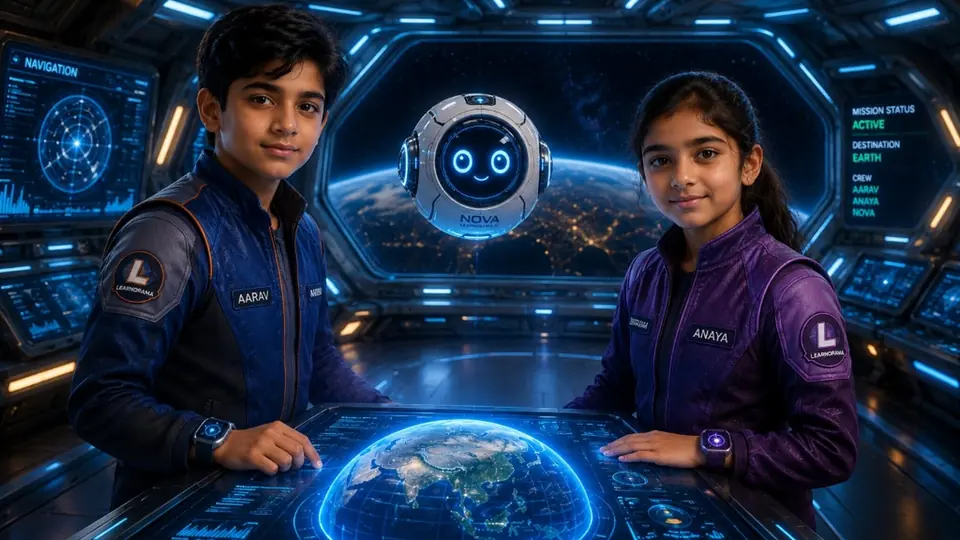
For decades, the standard educational model has revolved around passive consumption: listening to lectures, memorising text from physical pages, and taking high-stakes written examinations. While this structure established basic literacy in the industrial age, it is no longer sufficient in an era shaped by artificial intelligence, autonomous systems, and rapid scientific discovery.
The Shift From Information to Experience
At Learnorama, our founding philosophy is rooted in a fundamental cognitive truth: Children remember what they experience. When a child passively watches a video about gravitational forces, their brain retention decays rapidly over days. But when that same child steps into a cinematic physics mission—simulating orbital escape velocities and calculating Lagrange points inside an Explorer Pod—the concept becomes an indelible mental model.
We want students to discover knowledge—not simply consume it. When curiosity and active challenge lead the learning process, students engage at a fundamentally higher cognitive level.
NOVA: Socratic Intelligence That Liberates the Learner
Rather than treating Artificial Intelligence as a tool for automated homework completion or robotic grading, Learnorama designed NOVA as a Socratic learning companion. NOVA does not spoon-feed direct answers. Instead, it poses probing, scaffolding questions that encourage the student to analyze data, reflect on assumptions, and deduce answers independently.
By tracking 7 continuous learning signals—such as concept mastery velocity, persistence during failure, and metacognitive reflection depth—NOVA enables educators and parents to understand how each child learns, rather than relying solely on numerical marks.
Bridging the Classroom and the World Ahead
The final pillar of future-ready education is experiential extension. Digital mastery must be balanced with real-world collaboration, hardware prototyping, and outdoor expeditions. When students combine coding algorithms with physical sensor circuits, or build teamwork through technology camps, they develop the resilience and leadership necessary to thrive in tomorrow’s world.