
CBSE chapters, as missions.
Each chapter becomes a short film students step inside, followed by an investigation that checks what they understood. Mapped to the CBSE syllabus for Classes 6 to 10.
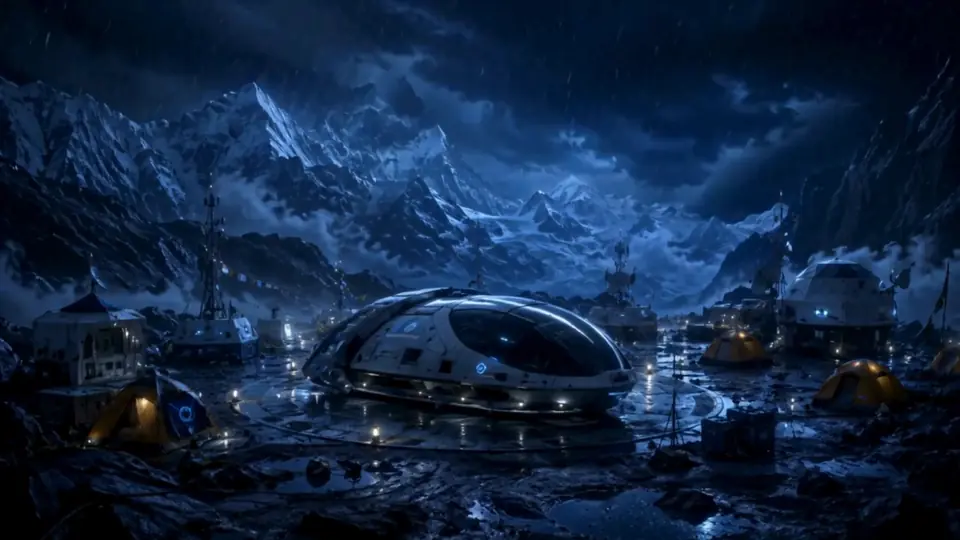
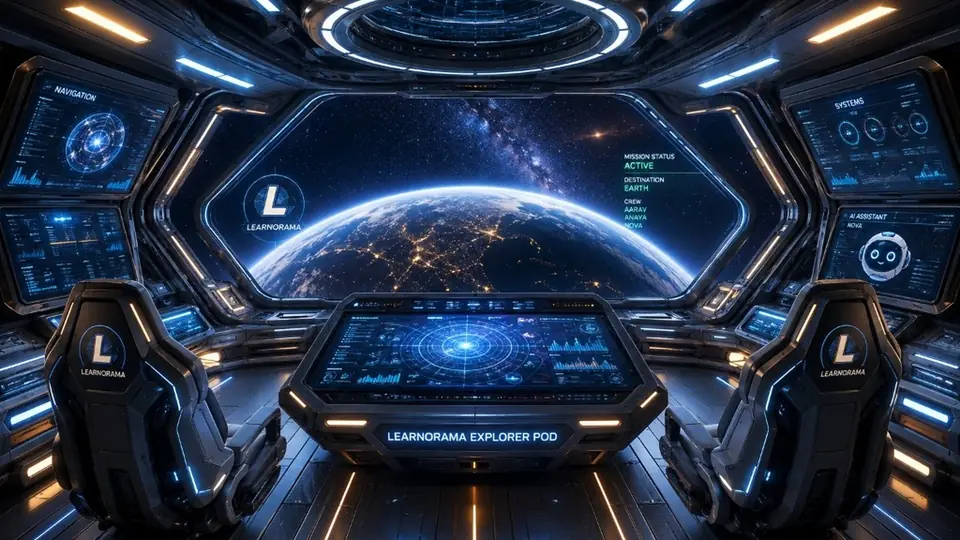
Mission Bharat is live.
Class 6 History (Social Science), chapter “India, That Is Bharat”. Students search for the land’s lost names and test each clue against evidence, the way a historian does.
- A 15-minute cinematic film
- 14 assessments, 100 marks
- Historian Explorer badge on completion
Inside a mission.
The same four parts in every chapter, so a class always knows where it is.
Briefing
NOVA sets the mission: what happened, what students need to find out, and why it matters.
The film
A short cinematic film carries students into the chapter’s world, on the classroom screen.
Investigation
Interactive assessments test each idea in turn, with hints and explanations when an answer is wrong.
Badge and report
Students earn the mission badge; teachers and parents see the scores in the LMS.
Screen recording of a cinematic lesson in the Learnorama LMS. The button below the film starts its assessments.
The map, Classes 6 to 10.
Each class follows its CBSE syllabus. Open a class to see its modules.
Class 6Foundational Scientific Investigation & World Explorationages 11–12
Early Indian history through Mission Bharat, introductory computational logic, and physical sciences.
Mission Bharat: India, That Is Bharat
How India got its names, reading historical sources and evidence, and thinking like a historian.
Foundations of Matter & Motion
Forces, motion principles, and physical states of matter.
Introduction to Algorithmic Logic
Algorithmic thinking, flowcharting, and structured problem decomposition.
Completion badge: Junior Explorer
Class 7Systems, Energy & Living Organismsages 12–13
Heat transfer, cellular biology, environmental cycles, and Python problem solving.
Thermal Physics & Energy Flow
Heat transfer mechanisms, thermodynamics, and temperature scales.
Cellular Life & Plant Physiology
Photosynthesis, nutrient cycles, and cellular organization.
Python Programming Foundations
Variables, conditions, loops, and mathematical modeling in code.
Completion badge: Systems Investigator
Class 8Forces, Pressure & Chemical Dynamicsages 13–14
Frictional dynamics, cell structure, synthetic materials, and computational data exploration.
Force, Pressure & Atmospheric Dynamics
Pressure equations, atmospheric gradients, and fluid mechanics.
Chemical Reactivity & Material Science
Combustion, synthetic materials, and conservation of mass.
Data Exploration & Algorithmic Problem Solving
Lists, dictionaries, basic data analysis, and scientific simulation.
Completion badge: Scientific Pioneer
Class 9Gravitation, Motion Laws & Deep Biologyages 14–15
Newtonian mechanics, work and energy, tissue biology, and applied scientific algorithms.
Laws of Motion & Universal Gravitation
Inertia, momentum conservation, gravitational acceleration, and Keplerian orbits.
Fundamental Unit of Life & Tissues
Organelle functions, cell division, and plant/animal tissue structures.
Applied Computational Science
Mathematical modeling of kinematics and biological systems.
Completion badge: Applied Science Scholar
Class 10Electromagnetism, Optics & Geneticsages 15–16
Circuit theory, light optics, carbon chemistry, heredity, and analytical capstone projects.
Electricity, Magnetism & Optical Rays
Ohm's law, electromagnetic induction, lens refraction, and mirror reflection.
Chemical Reactions, Carbon & Life Processes
Redox reactions, carbon bonding, respiration, and human circulatory physiology.
CBSE Board Synthesis & Capstone Investigation
Exemplary board examination mastery, practical reasoning, and concept synthesis.
Completion badge: CBSE Master Scholar
How missions teach.
Competency-Driven Progression
Learners advance through active mastery of concepts rather than passive rote memorization.
Experiential and Visual Pedagogy
Cognitive science-aligned cycles of visualize, hypothesize, experiment, and reflect.
CBSE and NEP 2020 Aligned
Seamless mapping to textbook chapters for Classes 6–10, enriching official school curriculum.
Personalized AI NOVA Guidance
Socratic inquiry companion that encourages critical thinking and active reflection.